
Training Your Response Before the Pressure Comes
Years ago, I learned a timeless truth: when your life hangs in the balance, it’s not the time to try something for the first time.
Before the fire, firefighters train. Before an engine fails, pilots drill for emergencies. Before the mission, soldiers rehearse. Those who endure and overcome make it a habit to prepare their hearts and responses long before life’s storms arrive.
Most of us understand this when the stakes are obvious. We wouldn’t want a pilot opening the emergency procedures for the first time while the airplane is losing altitude. But in everyday life, we sometimes do exactly that. We wait until we’re angry to practice patience. We wait until fear takes over to practice trust. We wait until the argument is underway to decide how we want to speak.
By then, we’re trying to learn in the middle of the emergency.
This is especially vital for biblical self-control. Biblical self-control isn’t something we suddenly manufacture in a moment of crisis. The Holy Spirit develops it in us as we learn to walk with Him before the pressure comes.
We’ve all wished we could go back thirty seconds and retrieve something we said. Maybe it was an argument with your spouse, a frustrating conversation with one of your children, or an email you should have left in the draft folder overnight. Someone pushes the right button, and suddenly you’re off to the races. The words come out, the temper rises, the anxiety takes over. Or you make a decision that feels good for about fifteen minutes and then leaves you wondering, What was I thinking?
Too often, we only consider self-control after it has already slipped through our fingers. Resilient faith calls us to a different path.
We prepare before the pressure arrives.
What Happens When the Trigger Hits?
In the last Resilient Faith article, we looked at the space between a trigger and our response. Something happens. We think about what happened. That thought generates emotion, and eventually we respond.
Trigger → Thought → Emotion → Response.
That space can seem tiny, especially when the trigger touches an old wound, fear, frustration, or insecurity. That’s why we practiced a simple sequence:
Pause. Pray. Evaluate. Choose.
That brief pause can change the direction of an entire conversation. But here’s the next question: How do you get better at using the pause when you really need it?
You practice it when you don’t need it. You train the gate before something comes crashing through it.
Pressure Reveals Our Training
Picture an ordinary day. You got a decent night’s sleep. The coffee was hot. Nobody has irritated you yet. It’s relatively easy to be patient and gracious. It’s easier to trust God when the bills are paid, the family is doing well, and the doctor hasn’t called with unexpected news.
Then life happens. You get tired. Someone disappoints you. Plans fall apart. The phone rings, or the test result comes back. Someone says something that hits a nerve, and almost instantly, the temperature inside you starts to rise.
Suddenly, the faith we proclaim on Sunday morning must stand firm on an ordinary Tuesday afternoon.
That’s when our training is put to the test.
Proverbs tells us:
“Better to be patient than powerful; better to have self-control than to conquer a city.”
— Proverbs 16:32, NLT
Our culture tends to associate strength with power, influence, assertiveness, or the ability to make things happen. Scripture often turns the world’s definition of strength upside down.
Sometimes the strongest person in the room is the one who can govern himself. The person who doesn’t have to say everything he’s thinking. The person who can feel anger without letting it take command, or feel fear without letting it make the decision.
The person who can pause long enough to ask, Lord, what would faithfulness look like right now?
This is the heart of self-control. And such strength does not appear by accident.
Biblical Self-Control Is More Than Willpower
This is where biblical self-control differs from simply gritting your teeth and trying harder. Paul includes self-control among the fruit produced by the Holy Spirit:
“But the Holy Spirit produces this kind of fruit in our lives: love, joy, peace, patience, kindness, goodness, faithfulness, gentleness, and self-control.”
— Galatians 5:22–23, NLT
Pay attention to the language here.
Fruit takes time to grow.
You don’t staple apples onto an apple tree. A healthy tree produces fruit because something is happening inside it. The same is true in our spiritual lives.
Self-control grows as we remain connected to God, learn His Word, listen to the Holy Spirit, and repeatedly choose obedience. This doesn’t mean we sit back passively. We cooperate with what God is doing in us.
Grace does not remove the need for training; it transforms the very source of our strength. We’re no longer striving to earn God’s approval. We’re learning to draw from the strength He so generously provides.
Think again about the firefighter, pilot, or soldier. Training doesn’t create the emergency. Training prepares them to respond when the emergency comes.
Our spiritual practices work much the same way. We don’t wait for the storm to begin before deciding where our anchor will be.
Your Brain Is Learning Too
Something else is happening during all this training. Our brains are learning.
One encouraging discovery from neuroscience is neuroplasticity, the brain’s capacity to change and adapt through repeated experience. Repeated patterns become easier to repeat, and that can work against us.
If I’ve rehearsed anger for years, anger can become a well-worn path. If I’ve responded to uncertainty with catastrophic thinking, my mind may travel that road almost automatically. If I’ve practiced avoidance every time I feel uncomfortable, avoidance becomes easier.
Imagine walking the same trail across an open field every day. Eventually, you don’t have to think much about where to step. The path is already there. Our responses can become like that. Something happens, and off we go down the familiar trail.
But here’s the encouraging part: the reverse is also true.
We can practice a different response. We can learn to pause, question a thought instead of automatically believing it, pray before speaking, and practice gratitude instead of immediately focusing on what’s wrong. We can learn to bring our emotions before God instead of letting them become our commander.
Over time, healthier responses become more familiar.
As a follower of Christ, I find this deeply encouraging. For centuries, Scripture has declared that our minds can be renewed and our lives transformed. Science offers another glimpse of how repeated, faithful practice allows God’s truth to take root in our daily lives.
So how do we train before the next storm arrives?
Train Your Mind
The first gate is often our thinking. Before the angry words, anxious reaction, impulsive decision, or withdrawal, there’s usually a thought: They don’t respect me. This is going to be a disaster. I can’t handle this. Here we go again.
Sometimes those thoughts are accurate. Sometimes they’re assumptions. Sometimes they’re old stories we’ve repeated so often that they feel like facts.
That’s why Scripture meditation matters. Biblical meditation isn’t emptying your mind. It’s filling your mind with truth and allowing that truth to challenge the stories running through your head.
Choose a verse and stay with it. Read it, write it down, say it aloud, and ask what it reveals about God, about you, and about the situation you’re facing.
One of my favorites for this particular kind of training comes from Psalm 141:
“Take control of what I say, O Lord, and guard my lips.”
— Psalm 141:3, NLT
Imagine praying that before the difficult meeting, rather than after. Before the family conversation. Before answering the email. Before walking into a situation where you already know you’re likely to be triggered.
You’re rehearsing the response before the pressure arrives.
Train Your Spirit
Prayer shouldn’t be the spiritual equivalent of breaking the glass and pulling the emergency handle.
Prayer is training.
So are worship, gratitude, Scripture, fasting, and quiet time with God. These practices don’t earn God’s favor. They open our hearts to His presence and help us become more responsive to His leading.
A simple morning prayer might be:
Lord, I don’t know everything I’ll face today. Help me notice when I’m becoming reactive. Give me wisdom before I speak and strength to choose what honors You.
It may take thirty seconds, but repeated day after day, it begins establishing an orientation: I am not facing today alone.
Then, when Tuesday afternoon arrives, and something goes sideways, you’re not introducing yourself to God for the first time that week. You’ve already been talking with Him.
Gratitude does something similar. When we deliberately notice God’s goodness, we’re training our attention. Instead of letting our minds get consumed by everything wrong, we remind ourselves that hardship isn’t the whole story.
Sometimes training also means voluntarily saying no. That’s one purpose of fasting. We practice saying, I don’t have to obey every appetite simply because it showed up.
It’s quiet, ordinary, often unnoticed training. But it’s preparing the guard.
Train Your Habits
Discipline doesn’t have to be harsh. In fact, good discipline is kind and steady, not harsh or shameful.
Some people begin a new spiritual practice as though they’re reporting to boot camp. Tomorrow morning they’re going to pray for an hour, read six chapters of the Bible, journal three pages, memorize four verses, exercise, drink eight glasses of water, and probably learn Greek before breakfast.
By Thursday, they’re exhausted.
Start smaller.
Maybe it’s five or ten minutes of Scripture, a short prayer before you pick up your phone, thirty seconds to check how you’re feeling before you enter the house after work, or one verse you carry throughout the week. Maybe it’s one trusted friend who has permission to ask how you’re really doing.
Small, faithful practices repeated day after day are far more powerful than grand efforts that vanish after a few days.
And when you stumble, and you will, confession becomes part of your growth. You don’t have to hide, pretend, or condemn yourself. Tell the truth: Lord, I blew that one.
Then ask: What triggered me? What was I telling myself? What could I practice before that happens again?
This is not failure.
That’s an After Action Review. You look at what happened, learn from it, and return to training.
Don’t Train Alone
One of the most overlooked tools for developing self-control is community. We need people who love us enough to encourage us and occasionally tell us the truth.
Ask yourself:
Who has permission to correct me?
That’s not an easy question. But resilient people usually have someone who can say, “You seem pretty wound up today.” Or, “You’ve told that story three times, and every time you sound angrier.” Or simply, “How are you really doing?”
We were never meant to build resilient faith in isolation. Sometimes God uses another believer to reveal the gate we’ve left unguarded, and sometimes that person sees the warning signs before we do.
Your Field Exercise: Guard One Gate
Let’s bring this down to where we live.
Don’t try to overhaul your entire life this week. Choose one gate.
Think of one situation where you tend to lose control of your words, thoughts, emotions, or reactions. Maybe it’s a particular relationship, driving in traffic, social media, worrying late at night, feeling criticized, or simply what happens when you’re tired.
You probably already know your gate.
Identify it, and don’t wait until you’re standing at the gate to decide what you’re going to do. Prepare beforehand.
Choose one Scripture. Pray before you enter the situation. Think about what usually triggers you. Decide what your pause will look like.
Then, for the next seven days, pay attention. When the trigger comes:
Pause. Pray. Evaluate. Choose.
You won’t do it perfectly. That’s okay.
We’re training.
The Day the Training Pays Off
Eventually, the moment comes.
Maybe it’s the same conversation that got away from you six months ago. The same person says the same kind of thing. You feel the familiar surge. Your heart rate picks up, and your mind starts heading down that familiar trail.
You know where this usually goes.
But this time, something is different.
You notice what’s happening. There’s a little more room between the trigger and your response than there used to be. You pause. You pray. You remember what’s true.
And instead of simply reacting, you choose.
Maybe nobody else in the room even notices what just happened. But you do.
Because six months ago, you would have said it. You would have sent it. You might have spent the rest of the evening replaying the conversation in your head.
This time you didn’t.
Not because you’ve suddenly become a model of perfect self-control. Not because you’ve finally developed enough willpower.
You’ve been practicing.
One prayer. One pause. One restrained word. One thought challenged by Scripture. One apology offered. One decision to try again tomorrow.
Resilient faith is not forged in dramatic moments alone. It is shaped in hundreds of ordinary moments.
The Holy Spirit works through them. Our minds learn. Our habits change. Our character is strengthened.
And when the pressure comes, those quiet moments of preparation begin to show.
This is no accident.
You’ve been training the guard.
Links to John’s Shortcast
How to Slow Down Your Triggers
This article is part of the Guarding the Gate series from John Thurman’s forthcoming book, Resilient Faith: Standing Strong in the Storms of Life.
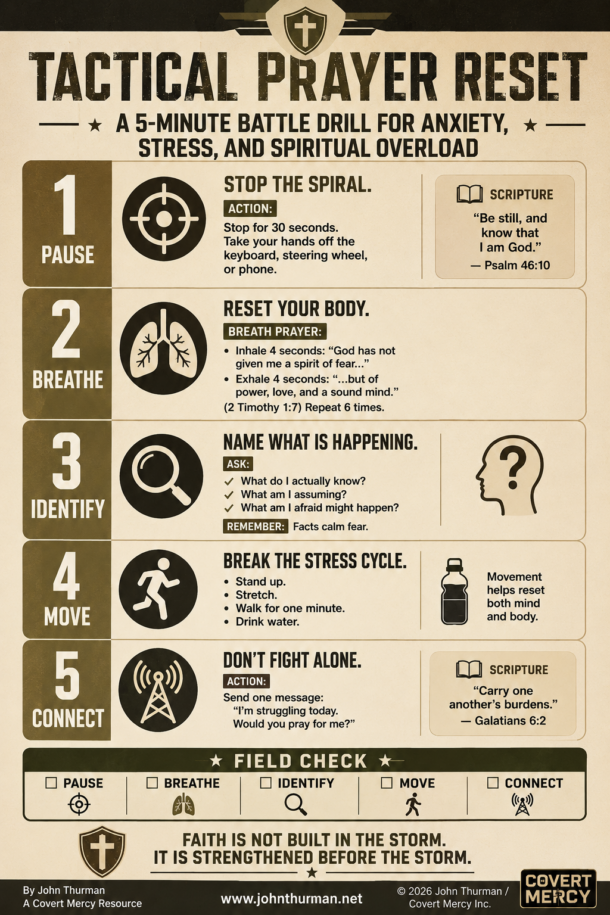
If you’d like a practical tool for those moments when pressure rises, download the free Tactical Prayer Reset. It’s designed to help you slow the moment down, refocus on what’s true, and respond from faith rather than fear.
Recent Comments