
In the first part of Guarding Your Gate, we talked about paying attention to what gets access to your mind and heart. What voices are you listening to? What thoughts are you rehearsing? What are you allowing through the gate?
But guarding the gate has another side.
What happens when something gets through and hits a nerve?
It might be a comment from your spouse, an email from your boss, an unexpected criticism, or simply a certain tone of voice. Your phone rings, you see the name, and before you even answer it, something is already happening inside you.
Your heart rate changes. Your muscles tighten. Your mind speeds up. Maybe you become angry or defensive. Maybe you shut down.
The Sentry just sounded the alarm.
And that brings us to an important question:
What happens between the trigger and your response?
When the Sentry Sounds the Alarm
I've written before about what I call your Sentry—that part of your brain constantly scanning your environment for anything that might represent danger. Your Sentry is trying to protect you, and that's a good thing.
If a truck suddenly pulls into your lane on I-40, you don't want your brain forming a committee to discuss the available options. You want it to react. Quickly.
But sometimes the Sentry sounds the alarm when the danger isn't quite so obvious.
Someone criticizes you or doesn't return your call. Your spouse says something with that tone. You feel ignored, embarrassed, rejected, or disrespected, and the alarm goes off.
Here's something worth remembering:
Your first reaction is information. It doesn't have to become your instruction.
Feeling something strongly doesn't necessarily mean you need to act on it immediately. The alarm may be real, but the alarm doesn't have to run the building.
The Story We Tell Ourselves
For years I've taught a simple way of understanding stress and anxiety. Something happens, we have a thought about what happened, and that thought influences what happens next.
I've sometimes described this as an Activating Event, our Thoughts about that event, and the Consequences that follow.
The interesting thing about triggers is how quickly that middle part happens.
Your spouse seems unusually quiet, and your mind says, They're angry with me. Your boss asks if you have a minute, and immediately you think, I'm in trouble. Someone questions a decision, and before you know it, you've moved from They disagree with me to They don't respect me.
The event may be real.
But the story you're telling yourself about the event may or may not be true.
That's why we need some space.
When Yesterday Walks Into Today
Triggers can become especially powerful when something happening today touches something that happened yesterday.
A criticism may touch an old wound of never feeling good enough. Someone's silence may awaken an old fear of rejection. Conflict may remind you of a home where anger wasn't safe. A loss may stir grief you thought you had already dealt with.
Suddenly, you're not responding only to what happened five minutes ago.
Yesterday has walked into today.
That doesn't mean the present situation isn't important. It simply means there may be more happening inside you than what's happening around you.
After decades of sitting with people in counseling rooms, ministry settings, and crisis situations—and dealing with a few of my own reactions along the way—I've learned that one of the healthiest questions we can ask ourselves is:
What is this really about?
Not as condemnation. As curiosity.
Sometimes that question alone creates the space we need.
When Your World Gets Small
When your Sentry believes something is threatening, your body gets involved too.
Lt. Col. Dave Grossman has spent years teaching about what happens to people under intense stress. In On Spiritual Combat, he and Adam Davis bring many of those insights into the context of faith and spiritual readiness.
Positive psychology has uncovered something helpful, too. Fear, anger, and other negative emotions can narrow our thinking. When we're highly activated, our world can shrink very quickly.
You've probably experienced this.
When you're triggered, suddenly there seem to be only a handful of options: fight back, get out, shut down, send the email, say the thing, prove your point.
But the first response you see isn't necessarily the best response available to you.
You may need enough space to see another one.
A few seconds can make a surprising difference. Breathe. Pray. Check the facts. Remember what's true. Once the alarm settles a little, you may discover another option—and maybe another after that.
That's one of the things resilience does.
It gives wisdom enough room to show up.
Don't Believe Everything You Think
Neurosurgeon Dr. W. Lee Warren uses the memorable idea of “self-brain surgery”—learning to examine our thinking rather than automatically accepting everything our minds produce.
I like that picture because not every thought that enters my mind deserves permanent residency. And not every thought deserves to be believed.
Sometimes we need to perform a little thought biopsy.
Is this actually true? What do I know, and what am I assuming? Is this really about what's happening right now, or did something old just get activated?
This is where Scripture becomes intensely practical. Paul tells us to “take captive every thought to make it obedient to Christ” (2 Corinthians 10:5).
That's not pretending difficult feelings don't exist. It's not positive thinking, and it certainly isn't spiritual denial.
It's refusing to let every thought that walks through the gate set up camp.
Creating a Little Space
So what can you do when the Sentry sounds the alarm?
Start by paying attention.
Maybe your chest tightens. You feel yourself getting angry. You suddenly want to leave the room. Something about a comment hits you harder than you expected.
Instead of immediately reacting, get curious about the feeling.
What just happened? Why did that hit me so hard? What am I telling myself about this?
Then ask one of the most useful questions I know:
What is actually true right now?
Not what you're afraid might happen. Not what you assume the other person meant. Not the story your brain has already started writing.
What do you actually know?
Then ask, What is the next right thing for me to do?
You don't have to solve the entire situation. Maybe you need to ask a question. Maybe you need to listen. Maybe you need to say, “Give me a minute.” Perhaps you need to apologize or walk around the block before answering that email.
And occasionally, the most spiritually mature thing you can do is keep your mouth shut for another thirty seconds.
James tells us to “be quick to listen, slow to speak, and slow to get angry” (James 1:19, NLT).
That's excellent spiritual advice.
It's also good psychology.
Take Back the Next 60 Seconds
Sometimes you won't have twenty minutes to process what's happening. You'll have sixty seconds. Maybe less.
That's why I like simple tools.
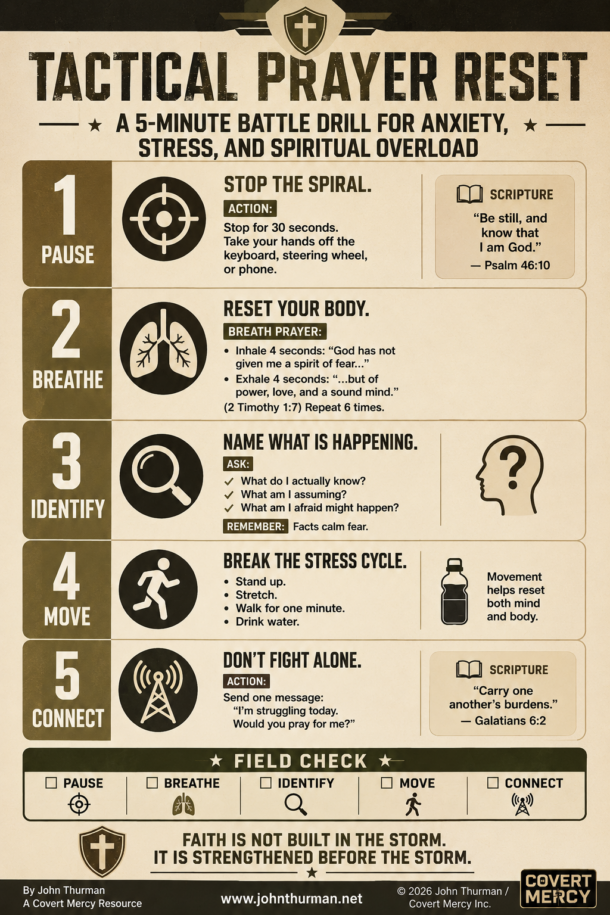
When you feel the alarm going off, pause and use the 4-4-4 breathing pattern we've practiced before. Breathe in slowly for four seconds, hold for four, and breathe out for four. Repeat it a few times.
You're not trying to make the problem disappear. You're simply slowing things down enough to create a little space between the alarm and what you do next.
And while you're breathing, pray something simple:
Lord, help me see clearly.
Or:
Holy Spirit, help me choose my next response.
Then come back to two questions: What is true? What is mine to do next?
That's guarding the gate in real time.
The Holy Spirit Meets Us in the Space
For those of us who follow Jesus, there's something more happening in that space.
We aren't there alone.
The space between the trigger and our response can become a place where we challenge the story our mind is telling us, check it against what is actually true, and give the Holy Spirit room to redirect us.
Paul reminds us in Galatians 5 that one of the fruits of the Spirit is self-control.
Self-control doesn't mean we never feel angry, afraid, hurt, or overwhelmed. It means those feelings don't have to become our commanding officer.
We can feel something deeply and still choose wisely. We can be angry without becoming destructive. We can be afraid without allowing fear to make every decision. We can feel rejected without automatically assuming we've actually been rejected.
And we can be hurt without immediately hurting someone else.
That's maturity. That's growth.
And that's resilient faith.
Guard the Space
You're probably not going to eliminate every trigger from your life. I'm not sure that's even the goal.
People will still say things. Plans will change. Memories will surface. Someone will misunderstand you. Your spouse may still use that tone. And somebody will still pull out in front of you on I-40.
The alarm will go off.
But the alarm doesn't have to run the building.
You can learn to recognize what's happening. You can become curious about the story you're telling yourself. You can slow things down, check what's true, invite the Holy Spirit into the moment, and choose what happens next.
You may not always get to choose what triggers you.
But with God's help, you can learn to choose what happens next.
And every time you practice that, something begins to change. The space gets a little wider. Old reactions have a little less control. Wisdom gets a little more room. Grace gets a little more room.
And the Holy Spirit gets another opportunity to remind you of what is true.
So this week, don't try to fix every trigger.
Just start noticing the space.
Because sometimes the difference between reacting out of an old wound and responding out of resilient faith comes down to a few seconds.
Guard those seconds. They matter.
Want to practice this? Download the free Guard One Gate — 7-Day Challenge.
Need help in the moment? Get the Free Tactical Prayer Guide
Sources & Further Reading
Lee Warren, M.D., Self-Brain Surgery. Hardback, Kindle, Audible
Dave Grossman and Adam Davis, On Spiritual Combat: 30 Missions for Victorious Warfare. Imitation Leather Paperback Kindle
Barbara L. Fredrickson, research on positive emotions, resilience, and the broaden-and-build theory.
Scripture references: 2 Corinthians 10:5; James 1:19; Galatians 5:22–23. Scripture quotation is from the New Living Translation (NLT).