
Have you ever said something and almost immediately wished you could pull the words back?
Maybe someone made a comment that hit a nerve. An email landed in your inbox at exactly the wrong moment. A family member pushed a button they've been pushing for years.
Or maybe it wasn't anger at all.
Perhaps fear took over. You received unexpected news, and within minutes your mind had traveled ten miles down a road that hadn't even happened yet.
Most of us know those moments. Something happens. Something rises inside us. And before we've had much time to think, we react.
Sometimes the Send button works considerably faster than the Holy Spirit might prefer.
If any of this sounds familiar, there is good news.
You don't have to control everything happening around you to live with resilient faith.
In fact, you can't.
But you aren't left to handle those moments alone. God has given you His Spirit. With the Holy Spirit's help, you can learn to guard what happens within you and choose your next faithful response.
The Bible calls part of that self-control.
And it may be one of the most overlooked strengths of the Christian life.
Hope Doesn't Mean the Storm Stops
Over the past several weeks, I've been writing about biblical hope.
Biblical hope isn't wishful thinking or pretending everything will turn out the way we want. Our hope rests in the character and promises of God.
But that raises an important question:
How do we live from that hope when the pressure is actually on?
It's one thing to believe God is faithful on a quiet morning. It's another to remember that when someone hurts us, the medical report isn't what we wanted, a relationship becomes strained, or fear starts telling us what tomorrow will look like.
That's where we're going next.
Over the past several years, I've been developing these ideas as part of my forthcoming book, Resilient Faith: Standing Strong in the Storms of Life. Over the next several weeks, I want to share some of the practical, tactical skills at the heart of that work—tools that can help us live out what we believe when life gets difficult.
One of the first is learning to guard the gate.
A City Without Walls
“A person without self-control is like a city with broken-down walls.”
— Proverbs 25:28 NLT
For people living in the ancient world, city walls weren't decorative. They meant protection.
Walls established a perimeter. Gates controlled access. Guards watched for threats. A city whose walls had been breached was exposed and vulnerable.
That's a powerful picture of our inner lives.
When we stop guarding the gate, things never intended to command us can begin making decisions for us.
Anger gets through. Fear gets through. Temptation gets through.
An impulsive thought becomes an impulsive action. A moment of frustration becomes a damaging conversation. Fear begins writing a story about tomorrow before tomorrow even arrives.
And worry has an impressive ability to hold meetings about problems that haven't happened yet.
Guarding the gate doesn't mean pretending these emotions aren't there. Anger, fear, disappointment, and hurt can tell us something important about what's happening inside us.
But there's a difference between noticing an emotion and handing it command authority.
Resilient faith learns that difference.
The Surprising Truth About Self-Control
There's an interesting paradox in the phrase self-control.
Scripture calls it self-control, but then tells us we don't develop it entirely by ourselves.
“But the Holy Spirit produces this kind of fruit in our lives: love, joy, peace, patience, kindness, goodness, faithfulness, gentleness, and self-control.”
— Galatians 5:22–23 NLT
Self-control is a fruit of the Holy Spirit.
Biblical self-control isn't simply gritting our teeth, trying harder, and promising ourselves we'll do better next time.
God is at work within us.
“For God is working in you, giving you the desire and the power to do what pleases him.”
— Philippians 2:13 NLT
I find that tremendously hopeful.
God isn't standing at a distance saying, Control yourself.
He is present and active in the life of the believer.
At the same time, He doesn't treat us as passive participants. The Holy Spirit empowers, but we respond. He guides, but we listen. He convicts, but we decide whether to surrender. He reminds us of the truth, but we decide whether we'll act on it.
“So I say, let the Holy Spirit guide your lives. Then you won't be doing what your sinful nature craves.”
— Galatians 5:16 NLT
Maybe the goal isn't simply becoming better at controlling ourselves.
The deeper goal is becoming increasingly responsive to the Holy Spirit.
That's when guarding the gate becomes more than a psychological technique. It becomes part of our daily walk with God.
You Can't Control Everything—and You Don't Have To
Psychology gives us a useful concept called locus of control. In simple terms, it has to do with whether we believe our choices and actions matter.
A healthy sense of personal agency doesn't mean believing we can control everything. In fact, maturity often means recognizing just how much we cannot control.
We can't control another person's opinion of us—which is unfortunate, because some of us have invested considerable time trying.
We can't guarantee how someone will respond to what we say. We can't rewrite yesterday, and no amount of worrying can guarantee tomorrow.
There are diagnoses we didn't choose, financial setbacks we didn't anticipate, family problems we can't fix by ourselves, and storms that arrive without asking permission.
We can exhaust ourselves trying to control things God never placed under our command.
But recognizing that doesn't leave us powerless. It frees us to concentrate on what God has placed before us.
I may not control another person's words, but I can ask the Holy Spirit to guard mine.
I may not control tomorrow, but I can refuse to let fear make today's decisions.
I may not be able to change yesterday, but I can decide whether yesterday will control how I live today.
I may not control the outcome, but I can pray, listen, tell the truth, forgive, establish a healthy boundary, ask for help, or take whatever faithful step God places in front of me.
Sometimes resilient faith begins right there—learning the difference between what needs to be surrendered to God and what God is asking us to do.
A Ten-Second Prayer Can Change What Happens Next
“Take control of what I say, O LORD, and guard my lips.”
— Psalm 141:3 NLT
That's a tactical prayer if I've ever heard one.
Imagine praying it before walking into a difficult meeting or family conversation. Pray before answering when you're angry or responding to the email that irritated you.
Lord, guard this gate.
And perhaps add:
Holy Spirit, guard my heart, guide my thoughts, and help me choose my next faithful response.
You don't need a thirty-minute quiet time before every difficult conversation.
Sometimes resilient faith looks like a ten-second prayer—which is particularly helpful when the person irritating you is standing three feet away.
That small pause creates room to listen before reacting.
Maybe you don't send the email yet. Maybe you'll listen a little longer. Maybe you tell the truth—but tell it gently.
Perhaps you apologize, wait, forgive, ask for help, or remain quiet for another minute.
And sometimes self-control doesn't mean remaining quiet at all. The Spirit may give us the courage to speak, establish a needed boundary, make a difficult decision, or take an action we've been avoiding.
The issue is not simply restraint. It is Spirit-directed response.
Learning to Guard the Gate
So, how do we begin?
Not by trying to overhaul our entire personality by Friday.
Start with one situation.
Think of a place where your reactions tend to get ahead of you. Maybe it's a particular relationship. Maybe it's worry late at night. Maybe it's the news, money, family conflict, criticism, or the temptation to fire off an immediate response when you feel misunderstood.
The next time you feel that familiar reaction beginning, pause long enough to notice it.
I'm angry. I'm afraid. I'm hurt.
Naming what you're feeling doesn't give the feeling control. It helps you recognize what's happening at the gate.
What am I trying to control right now?
You may discover you're trying to control another person, an outcome, something that has already happened, or something that hasn't happened yet.
What is actually mine to do?
That's where we invite the Holy Spirit directly into the moment.
Holy Spirit, how would You have me respond?
You may not receive a dramatic answer. Often Scripture, wisdom, and the character the Spirit is already developing in us provide plenty of direction.
Is the response you're considering consistent with love? Patience? Kindness? Gentleness? Self-control?
Then ask one final question:
What is my next faithful step?
Not the next ten. Just the next one. And take it.
Give God What Belongs to God
“Give all your worries and cares to God, for he cares about you.”
— 1 Peter 5:7 NLT
Some things need to be acted upon. Others need to be released.
Wisdom is learning the difference.
When something isn't yours to control, deliberately place it into God's hands:
Father, this is beyond me. I give it to You. Holy Spirit, show me what is mine to do and give me the strength to do it faithfully.
That's where self-control and hope meet.
I don't have to control the outcome because God is still God.
And because God is still God, I'm free to concentrate on the responsibility He has placed in front of me.
That doesn't guarantee the outcome I want.
It gives me something better: a faithful way to walk through an outcome I cannot control.
Field Note: Guard One Gate This Week
For the coming week, choose one situation where you tend to lose control of your thoughts, emotions, or words.
Don't try to fix everything.
Choose one gate.
Before entering that situation, pray Psalm 141:3:
“Take control of what I say, O LORD, and guard my lips.”
When you feel yourself reacting, remember this simple sequence:
Notice what you're feeling. Name what you're trying to control. Surrender what belongs to God. Ask the Holy Spirit how to respond. Then take the next faithful step.
You probably won't do it perfectly.
That's okay. This is training, not a final exam.
Every time you pause instead of immediately reacting, you're practicing. Every time you surrender something you cannot control, you're practicing. Every time you seek the Holy Spirit's guidance before responding, you're practicing.
And every time you choose a faithful response instead of an impulsive one, you're practicing.
Over time, the Spirit uses those repeated acts of surrender and obedience to shape our character.
That's how resilient faith grows.
One gate. One choice. One faithful step at a time.
Next: The Space Between the Trigger and Your Response
There's still an important question.
What actually happens in those few seconds between something triggering us and our response? Why can our reactions feel so automatic?
And can we learn to interrupt that sequence before it takes over?
That's where we'll go next in this series:
The Space Between the Trigger and Your Response.
Because you may not be able to control the trigger.
But with practice, biblical truth, and the help of the Holy Spirit, you can learn to guard what happens next.
Guarding the Gate is part of an ongoing series drawn from themes in my forthcoming book, Resilient Faith: Standing Strong in the Storms of Life.
Want a Practical Tool for Difficult Moments?
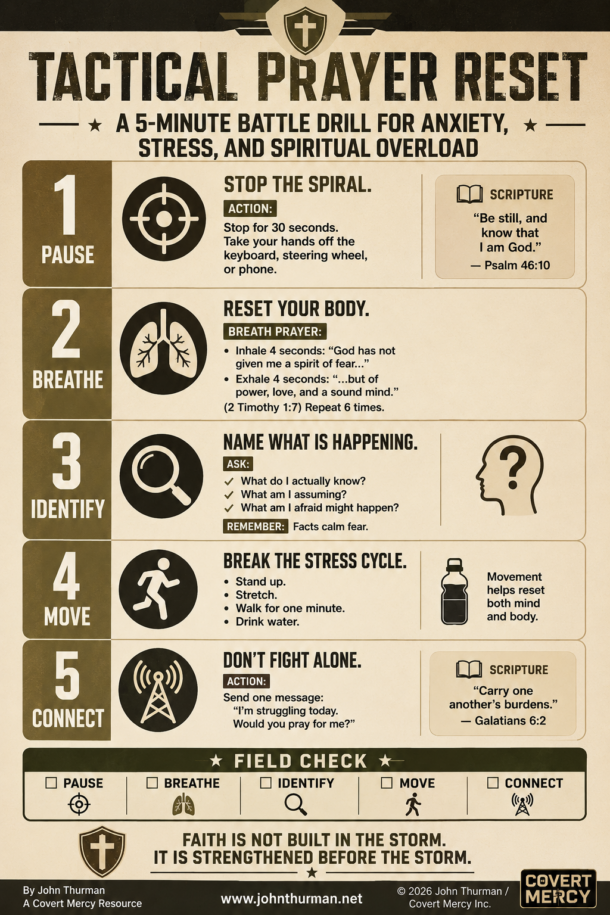
When stress, fear, or pressure starts taking over, it helps to have something simple you can actually use. My free Tactical Prayer Guide offers Scripture-grounded, practical steps to help you slow down, refocus, and take your next faithful step.
PUT THIS INTO PRACTICE
Reading about guarding the gate is one thing. Practicing it is another.
I’ve created a free two-page Guard One Gate: A 7-Day Resilient Faith Practice to help you identify one gate that needs your attention and make one intentional change this week.
Recent Comments