
Have you ever wished God would just hand you a map?
Not one of those maps that announces, “Recalculating,” every time you miss a turn. I’m talking about a map that shows you exactly where you’re going, what you’ll encounter along the way, and how everything will turn out.
I’d certainly appreciate one of those from time to time.
After decades of counseling people through some of life’s difficult seasons, I’ve noticed something about the decisions that trouble us most. Often, the real problem isn’t that we don’t know what to do. It’s that we don’t know what will happen after we do it.
And that uncertainty can keep us parked for a long time.
In our last conversation about resilient faith and decisiveness, we talked about guarding the gate of our minds. We explored that small but important space between something happening to us and how we choose to respond.
That space matters. It gives us time to catch our breath, consider the facts, seek God’s wisdom, and avoid doing something we’ll regret before lunch.
But I’ve been thinking about something else.
What happens when we’ve done all those things and we’re still standing at the gate?
At some point, we have to decide whether we’re going to step forward or spend another week examining the hinges.
When Waiting Becomes a Comfortable Hiding Place
I’ve sat with plenty of people who were wrestling with decisions that carried real consequences. Some were facing changes in their marriages or careers. Others were trying to move forward after a painful loss, a personal failure, or an unexpected disruption in life.
They weren’t foolish people. Many were thoughtful, responsible, and deeply committed to doing the right thing.
But something interesting often happened as we talked.
They could tell me what might go wrong. Some had developed an impressive collection of possible disasters. They rehearsed conversations that never happened, worried about reactions they never got, and imagined consequences that might never occur.
I sometimes wondered whether they had spent more energy worrying about the decision than the decision itself would ever require.
Of course, I’ve caught myself doing the same thing.
It’s remarkable how creative our minds can become when fear takes over the planning department.
Now, don’t misunderstand me. Sometimes, waiting is exactly what you should do. Wisdom sometimes tells us to slow down, gather more information, or seek counsel from someone who knows more than we do.
But there’s another kind of waiting. It’s the kind that feels responsible on the surface but is quietly driven by fear.
We tell ourselves we’re still thinking about it. We’re praying about it. We’re waiting for the right moment.
And sometimes we are.
Other times, we’re hoping that if we wait long enough, the uncertainty will disappear and the decision will somehow make itself.
Unfortunately, life seldom works that way.
Abraham Didn’t Get a Travel Brochure
I’ve always been fascinated by Abraham’s story.
In Genesis 12, God told Abram to leave his country, his relatives, and his father’s family and go to a land God would show him.
Think about that for a moment.
There was no detailed itinerary. No scouting report. No opportunity to look up the neighborhood, compare housing prices, or read reviews from people who had made the trip.
God told him to go.
And Abraham went.
Hebrews 11:8 says Abraham obeyed God and left, even though he didn’t know where he was going.
I’ve wondered what those first few days on the road must have been like. Did Abraham wonder how long the journey would take? Did he think about what he was leaving behind? Did he have moments when he wished God had provided a few more details?
Scripture doesn’t tell us, so I won’t pretend to know.
What it does tell us is that Abraham trusted God enough to take the next step.
That’s what catches my attention.
Abraham wasn’t wandering, hoping something good would happen. He was responding to the direction God had given him.
There is a world of difference between acting recklessly and moving forward in faith.
We aren’t Abraham, and we shouldn’t assume every strong feeling is a personal message from God. But his story reminds us that obedience doesn’t always come with a complete explanation.
Sometimes trusting God means moving forward with what He’s already made clear.
Proverbs 3:5–6 reminds us to trust the Lord wholeheartedly rather than depending entirely on our own understanding. As we seek His will, He promises to direct our path.
I’ve returned to those verses many times over the years, particularly when the road ahead seemed anything but clear.
Notice what Solomon doesn’t say. He doesn’t promise that God will explain every turn, remove every obstacle, or guarantee the outcomes we want from our decisions.
Instead, he reminds us where our confidence belongs.
And that’s something I’ve had to remember in some very practical situations.
During my years in crisis response, I learned that waiting for complete information wasn’t always an option. Sometimes the situation was changing faster than we could gather the facts. People needed help, decisions had to be made, and standing around waiting for perfect conditions could make a difficult situation worse.
In those moments, you learned to assess what you knew, acknowledge what you didn’t, listen to experienced people, and make the wisest decision possible under the circumstances.
Then you had to move.
Not because you were certain everything would work out exactly as planned, but because doing nothing had its own consequences.
Sometimes, after taking that first step, you discovered information that helped you make the next decision.
I’ve found that life works much the same way.
We pray, seek wise counsel, examine our motives, and consider what Scripture teaches. We use the minds God gave us. But eventually, we have to recognize that faithfulness doesn’t require us to predict the future.
It requires us to trust the One who holds it.
Sometimes a Lamp Is Enough
In Psalm 119:105, the psalmist describes God’s Word as a lamp for his feet and a light for his path.
I’ve always appreciated that image.
A lamp doesn’t illuminate the next twenty miles. It shows you enough of the path to keep from stumbling over what’s immediately in front of you.
Frankly, there have been times when I would have preferred a floodlight.
Maybe you have too.
But perhaps one of the lessons God teaches us through uncertainty is that we don’t have to see everything to trust Him with the next step.
Taking that step doesn’t mean everything will suddenly become easy. A wise decision can still lead through a difficult season. An uncomfortable outcome doesn’t automatically mean we misunderstood God or made the wrong choice.
Sometimes the real test of decisiveness comes after the decision, when we have to resist the temptation to second-guess ourselves every time the road gets rough.
Of course, when new information comes to light, wisdom may require us to adjust our course. That’s not failure. That’s responsible living.
But constantly reopening a sound decision simply because we’re uncomfortable with uncertainty can keep us from experiencing the peace that comes with trusting God.
So, if you’re facing a decision you’ve been putting off, I’d encourage you to consider something.
Perhaps you already know more than you think. Perhaps you’ve prayed, sought counsel, weighed the consequences, and considered what God’s Word says.
And perhaps what remains isn’t another round of analysis.
Perhaps it’s courage.
I don’t know what decision you’re facing today. It may be something relatively small, or it may be one of those choices that changes the direction of your life. Either way, I hope you’ll remember that God’s faithfulness isn’t dependent on your ability to get every decision exactly right.
He hasn’t promised us a trouble-free journey. But He has promised never to abandon His children. And perhaps that’s what we need to remember when we’re standing at a crossroads. We don’t need the whole map. We just need enough light to see where to place our foot today, and enough trust in His faithfulness to take that next step.
After all, fear doesn’t get to keep us permanently parked.
And resilient faith was never meant to spend its life in the driveway.
A Question for You
Is there a decision you’ve been putting off because you’re uncertain about what comes next? Sometimes putting that decision into words is the first step toward moving forward. If you’re comfortable sharing, I’d welcome your thoughts in the comments.
A Note from John
This article is part of my ongoing Resilient Faith series, drawing from the biblical principles and practical tools explored in my forthcoming book, Resilient Faith: Standing Strong in the Storms of Life. I hope to help you develop a faith that stands strong when life doesn’t go according to plan.
Need a Little Help Taking That Next Step?
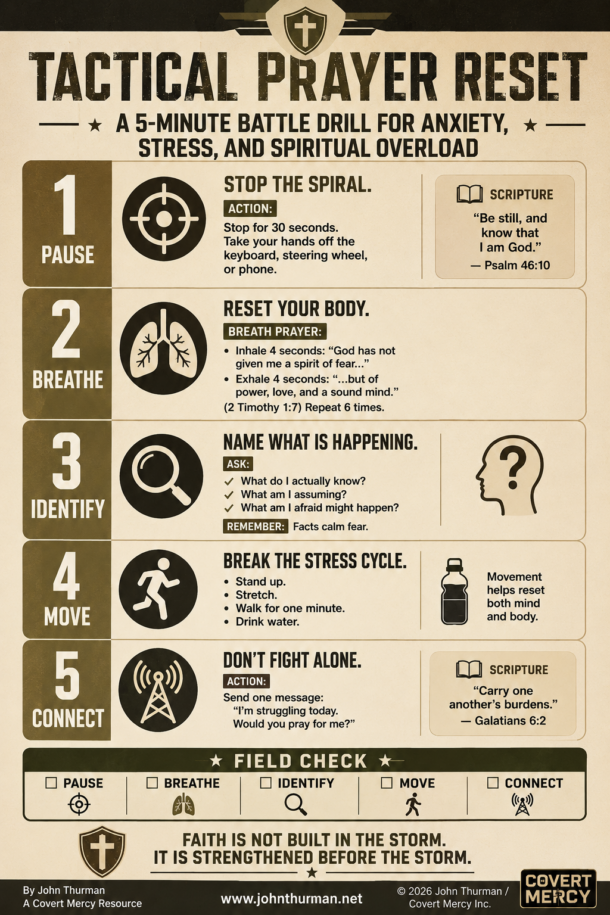
When fear or uncertainty makes a decision feel overwhelming, sometimes the best place to begin is with a simple prayer and a moment to regain your perspective. I’ve put together a free Tactical Prayer Guide with practical, Scripture-based tools to help you settle your thoughts, refocus on what matters, and move forward with greater confidence.