
For the past few weeks, we’ve been talking about guarding the gate. We’ve looked at what gets into our minds, what happens when something pushes one of our buttons, and that small but important space between a trigger and our response.
I believe deeply in that space. Sometimes it is just long enough to take a breath and pray, “Lord, help me.” Sometimes it keeps us from sending the text, firing off the email, or saying something we’ll wish we could take back five minutes later.
But I’ve been thinking about something else lately.
The space is not the destination. It is the place where we choose how to step forward.
Eventually, resilient faith has to move.
Some Training Never Leaves You
That thought takes me back many years.
During my Army days, we were trained to look carefully at a situation before acting. You needed to understand what was happening around you, identify the threat, separate what you actually knew from what you were assuming, take stock of the resources available, and figure out what you still needed to know.
The point wasn’t to admire your assessment. The point was to decide what to do next.
Some training never leaves you.
I hadn’t really thought about that connection until I began working through this idea of decisiveness. But I realized that old rhythm is still rattling around in my head. Only now, after years of ministry, counseling, crisis response, and life, I see another layer to it.
As followers of Christ, we also have to ask whether we have correctly identified the threat.
Paul reminds us in Ephesians 6 that “we are not fighting against flesh-and-blood enemies.” I don’t think we need to make that mysterious or dramatic, but we do need to take it seriously.
Because if I misidentify the threat, I may end up fighting the wrong battle.
The person who irritated me may not be the enemy, and neither may the difficult conversation itself. Sometimes the greater danger is what begins happening inside me because of it. Fear gets louder, anger starts writing the story, discouragement whispers that nothing will ever change, and accusation begins to sound like truth.
Scripture describes Satan as the accuser of God’s people. Revelation 12:10 speaks of the one who accuses them before God day and night. Again, I don’t think we need to get dramatic about that, but we shouldn’t ignore it either. Part of guarding the gate is learning to recognize the difference between accusation and truth.
Now that little space we’ve been talking about becomes enormously important. It gives me enough room to ask what is actually happening and perhaps to pray, “Lord, help me see this clearly.”
That is where discernment begins. Not with having all the answers, but with seeing clearly enough to recognize what is true and what may not be.
Decisiveness Is Not Certainty
Once I begin to see the situation more clearly, I can ask God for wisdom about what comes next.
James tells us that if we need wisdom, we should ask our generous God for it. I’ve prayed some long prayers in my life, but I’ve also prayed quite a few that amounted to, “Lord, I don’t know what to do here. Help me.”
Sometimes that is enough to get us started.
Of course, prayer doesn’t mean we stop thinking. Sometimes we need to open Scripture or call someone whose judgment we trust. Sometimes we need to ask another question, look at the numbers, make a phone call, or simply get information we don’t yet have.
That is part of wisdom.
But at some point, something subtle can happen. We keep looking and looking, believing that somewhere out there is one more piece of information that will finally make the decision obvious.
Years ago, I heard somebody call it the paralysis of analysis.
I’ve always liked that phrase because I’ve seen it in myself and in plenty of other people. We tell ourselves we’re being careful when we may actually be afraid to choose. We gather a little more information, have one more conversation, seek one more opinion, and give ourselves another day to think about it.
We can even spiritualize it: “I’m still praying about it.”
And sometimes we are.
But sometimes, if we’re willing to be honest, we already have enough information to make the decision. What we don’t have is a guarantee that we’re going to like the outcome.
That’s different.
We aren’t really waiting for wisdom anymore. We’re waiting for certainty.
And faith rarely gives us that luxury.
Joshua certainly didn’t have a guarantee about what everybody around him would do when he stood before Israel and said, “Choose today whom you will serve.”
Then he added:
“But as for me and my family, we will serve the LORD.”
—Joshua 24:15 NLT
I’ve always appreciated the strength of that statement. Joshua couldn’t choose for everybody else, and he couldn’t control tomorrow.
He could choose his direction.
Maybe that’s a better picture of decisiveness than the one we sometimes carry around. Being decisive doesn’t mean I’m absolutely certain I’m right. It doesn’t mean I charge ahead regardless of what anyone says. And it certainly doesn’t mean that once I’ve made a decision, I’m too proud to adjust when new information comes along.
Sometimes decisiveness simply means I have prayed, sought wisdom, looked honestly at what I know, and now it is time to put a foot forward.
When It’s Time to Move
That can be uncomfortable.
It would be nice if God occasionally wrote the answer across the New Mexico sky in letters big enough to read from the backyard.
So far, that has not been my experience.
More often, He gives us His Word, His Spirit, wise people around us, the information available to us, and then invites us to trust Him enough to move.
Maybe that is where you are today. Perhaps a decision has been taking up more mental real estate than it deserves. You’ve thought about it, prayed about it, talked about it, and maybe even analyzed your analysis.
At some point, it may be worth asking yourself one uncomfortable question:
Do I genuinely need more wisdom, or am I using the search for certainty to keep from moving?
You may not know exactly where the road leads. You may discover a few miles down it that you need to make a course correction.
That’s okay. Faithfulness isn’t the same thing as never changing direction.
But fear doesn’t get to keep us permanently parked.
Somewhere underneath all of this is that old rhythm that has stayed with me for years:
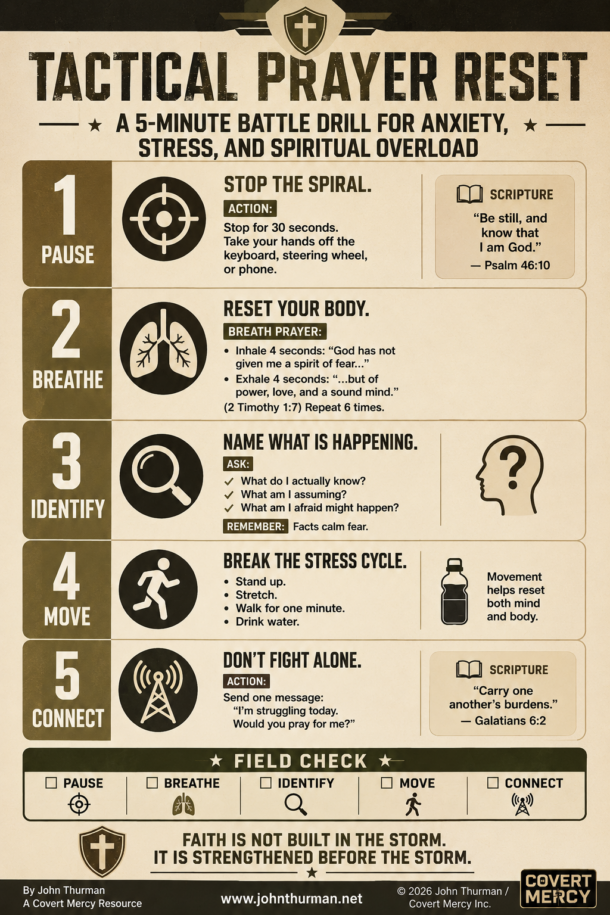
Discern. Pray. Seek. Choose. Move.
I don’t think of it as five steps. It’s more like a rhythm that has developed over a lifetime. See what is really happening and bring it before God. Seek the wisdom, counsel, or information you genuinely need. Then, when the time comes, choose a direction and put a foot forward.
That’s where this next layer of resilient faith takes us.
We guard the gate because what enters matters. We create space because our response matters. We use that space to see more clearly, listen more carefully, and choose more faithfully.
But we don’t build a house there.
The space is not the destination.
It is where we prepare to take the next faithful step.
This is one of the themes I’m exploring more deeply in my upcoming book, Resilient Faith: Standing Strong in the Storms of Life. Resilient faith is not simply about enduring the storm. It is learning how to respond faithfully when the next step is ours to take.